

The bell rings.
But this time, it does not bring the usual excitement of students rushing out of their classrooms to be with friends or to go home.
Afternoon classes are suspended, and students were advised to leave the school grounds. Soon after, a community lockdown is implemented. Classrooms fall silent as the safety of students takes priority.
In an instant, learning moves from school desks to dining tables, living rooms, and quiet corners at home as classes shift to distance learning.
For students, learning has to continue—but often without a teacher physically beside them.
At home, one student turns the pages of a mathematics module. Written across one page is an equation:
3(x + 4) − 5 = 2x + 11
For some, it is simply a problem waiting to be solved. But for a learner struggling with mathematics, the numbers, symbols, and unknown variables can feel like a wall between confusion and understanding.
The student reads the problem again. And again.
But not every learner has someone at home who can explain the hows and whys –- someone who can help make sense of what seems difficult.
If only there were someone I could ask for help.
It was a simple need shared by many learners—and one that would eventually find an answer through MATH-Tulungan: Mathematics Achievement through Tutoring and Hands-on Learning.
Instead of allowing learners to face difficult mathematical problems alone, MATH-Tulungan created opportunities for students to learn with the assistance of others. A classmate could become a peer tutor, turning unfamiliar equations could become a shared problem. And rather than simply providing an answer, the helping hand could begin with a question:
“What should we do first?”
One step. One explanation. One attempt at a time, the equation becomes less intimidating.
At the heart of MATH-Tulungan is a simple principle: difficult problems become more manageable when learners are given the right assistance, meaningful opportunities to practice, and someone willing to help them understand.
𝗧𝗵𝗲 𝗡𝘂𝗺𝗯𝗲𝗿𝘀 𝗕𝗲𝗵𝗶𝗻𝗱 𝘁𝗵𝗲 𝗡𝗲𝗲𝗱
The struggle, however, was not confined to a single learner trying to make sense of an equation at home. When teachers looked at the numeracy performance of their students, the numbers revealed a challenge that demanded attention.
Among 521 learners from Grades 7 to 10, only 64 were classified as Proficient/Highly Numerate. In contrast, 200 were Developing Numerate, 216 were Beginning Numerate, and 41 were classified as Non-numerate.
Put simply, only about 12 percent of the learners assessed had reached the proficient level, while nearly 88 percent were still at varying stages of developing their numeracy skills.
The situation was particularly concerning at the lower levels of numeracy. Grade 7 alone had 69 Beginning Numerate and 15 Non-numerate learners, while Grade 8 recorded 62 Beginning Numerate and 10 Non-numerate learners. Similar learning needs were evident in Grades 9 and 10.
Behind these classifications were learners with different stories and different levels of difficulty. Some needed reinforcement of fundamental mathematical concepts. Others needed more opportunities to practice. Still others needed something seemingly simple but difficult to provide when learning happened away from the classroom—someone who could guide them when they did not know what to do next.
The data confirmed what teachers were already encountering: providing learning materials alone could not always address the varying needs of learners. The challenge was no longer simply how to deliver mathematics lessons amid disrupted classes, but how to make sure that learners who needed additional help would not be left to struggle on their own.
That challenge became the compelling reason to establish MATH-Tulungan: Mathematics Achievement through Tutoring and Hands-on Learning
𝗙𝗿𝗼𝗺 𝗮 𝗟𝗲𝗮𝗿𝗻𝗶𝗻𝗴 𝗚𝗮𝗽 𝘁𝗼 𝗮 𝗛𝗲𝗹𝗽𝗶𝗻𝗴 𝗛𝗮𝗻𝗱
MATH-Tulungan grew from a need teachers could already see in their classrooms. It brought tutoring, individualized activities, and hands-on learning together to give students more opportunities to understand mathematics.
Its approach reflected the meaning embedded in its name—tulungan: a Filipino word meaning helping one another.
At the heart of the program was the idea that learning mathematics did not have to be an individual struggle. Through peer support, a learner who had already understood a concept could help another learner work through it. Through individualized tasks, students could practice according to their learning needs. Through hands-on activities, abstract mathematical ideas could become more concrete and understandable.
The goal was not to make mathematics easier by simply giving learners the answers. It was to make learning mathematics more accessible by giving them the support needed to discover and understand the answers themselves.
And as MATH-Tulungan continued, another set of numbers would eventually tell a different story.
𝗗𝗶𝗳𝗳𝗲𝗿𝗲𝗻𝘁 𝗡𝗲𝗲𝗱𝘀, 𝗢𝗻𝗲 𝗚𝗼𝗮𝗹
MATH-Tulungan was built on the understanding that learners do not enter the mathematics classroom at the same starting point. Some may still be finding their way through basic numeracy skills, while others are ready to take on more complex mathematical problems.
Hence, helping them could not mean giving everyone the same kind of help. Different learners need different support but all are working on the same goal: learning mathematics with greater confidence.
This recognition shaped the program into two complementary paths: Remediation and Enrichment.
For learners who struggle with mathematics, the first step is not simply another worksheet or another set of problems. It is finding out where the difficulty begins.
Diagnostic assessments help teachers identify skills that need strengthening. From there, learners receive targeted support through scheduled tutorial sessions facilitated by teachers and trained peer tutors. Drills, guided practice, concept reinforcement, and formative assessments give them opportunities to revisit concepts, correct misconceptions, and build their skills one step at a time.
It is in these sessions that the tulungan in MATH-Tulungan becomes more than a name.
A peer tutor sits beside a classmate and works through a problem with them. Another offers an explanation when the first one does not quite make sense. A teacher adjusts an activity when a learner needs more practice. The objective is not simply to arrive at the correct answer, but to help the learner understand how and why that answer is reached.
Yet helping learners move forward does not always mean helping them catch up.
For those who demonstrate greater aptitude in mathematics, MATH-Tulungan opens another path. Through enrichment activities, advanced problem-solving, competition preparation, and mentoring, these learners are challenged to stretch their abilities beyond regular classroom exercises. Mathematics achievers, alumni, and trained educators become part of that journey, helping learners discover just how far their skills can take them.
And the cycle continues.
Assessment and intervention work as a continuing cycle. As learners progress, teachers monitor the results and adjust the support according to what each learner still needs.
In this way, MATH-Tulungan meets learners where they are—providing a helping hand to those who need to strengthen foundational skills while creating opportunities for those ready to move further ahead.
But the helping hands do not come from the Mathematics Department alone.
Teachers, interns, peer tutors, and other members of the school community contribute to the effort. The General Parent-Teacher Association (GPTA) and the Supreme Student Learner Government (SSLG) provide support through giving learning materials and resources, while the school's digital initiatives offer additional tools for instruction and monitoring learners' progress.
What started as a response to a learning gap was gradually becoming something larger: a community of learners helping learners.
The change was beginning to show in the numbers.
From only 64 Proficient/Highly Numerate learners in the earlier assessment, the figure rose to 127 in SY 2023–2024. At the other end of the scale, the number of Non-numerate learners fell from 41 to 13. By S.Y. 2024–2025, 84% of students reached Developing to Approaching Proficiency levels, with 11% achieving Proficient or Advanced status, demonstrating not only numeracy recovery but readiness for higher-level mathematical thinking.
More important than the changing figures was what they represented: learners gradually moving away from difficulty and toward greater confidence and competence in mathematics.
𝗕𝗲𝘆𝗼𝗻𝗱 𝘁𝗵𝗲 𝗖𝗹𝗮𝘀𝘀𝗿𝗼𝗼𝗺
The progress did not remain within the walls of the mathematics classroom.
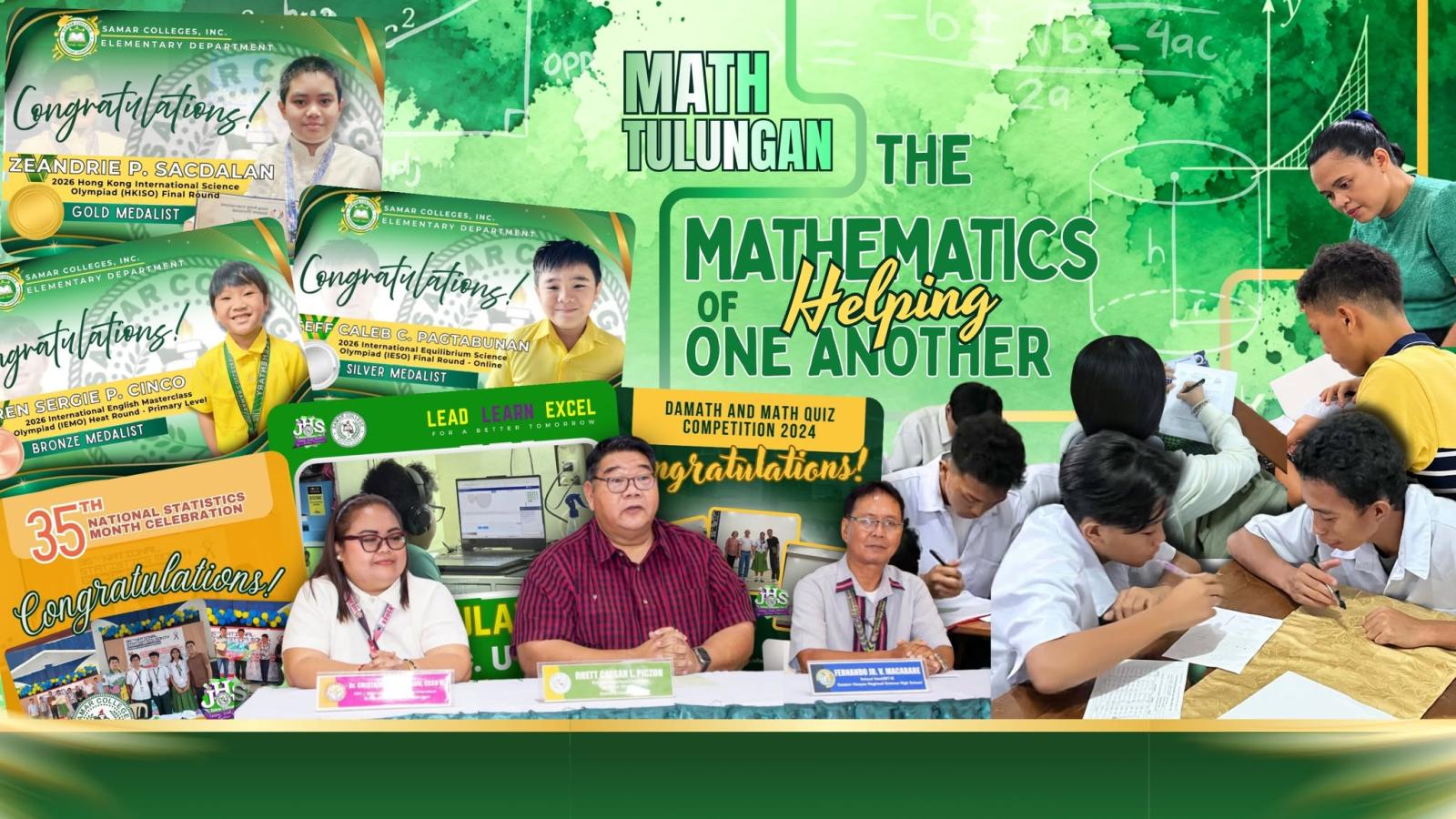
From S.Y. 2022 to 2025, learners brought home 27 awards from local and international mathematics competitions, carrying their growing skills into arenas where they were challenged to think critically, reason analytically, and solve problems under pressure.
For MATH-Tulungan, these achievements added another dimension to its story. The program was created to help learners who needed support, but its enrichment component also gave mathematically inclined students opportunities to push their abilities further.
Some learners needed a helping hand to understand the next step in an equation. Others needed a challenge that would take them beyond it.
MATH-Tulungan made room for both.
And perhaps that is where the meaning of tulungan comes full circle. A learner who once needed guidance can eventually gain the confidence to solve independently, take on greater challenges—and even become the helping hand for someone else.
𝗘𝘅𝘁𝗲𝗻𝗱𝗶𝗻𝗴 𝘁𝗵𝗲 𝗥𝗲𝗮𝗰𝗵
The challenge, however, extends far beyond the walls of one school.
In the Organisation for Economic Co-operation and Development’s PISA 2022 results, only 16% of Filipino students reached baseline Level 2 proficiency in mathematics, significantly below the OECD average of 69%-– figures that tell a larger story of learning challenges that extend beyond any single institution.
Recognizing that learning gaps are not confined within its own classrooms, Samar Colleges, Inc. (SCI) sought to extend its learning interventions beyond its walls.
This opened the way for PROGRAM CONNECT: Community Network for Continuity of Learning, a partnership among SCI, the Schools Division Office of Catbalogan City (SDO-Catbalogan City), and Eastern Visayas Regional Science High School (EVRSHS). The program brings together the Moodle-Based Learning Management System, ResiLearn, and MATH-Tulungan as a package of learning support designed to help sustain learning even when regular classes are disrupted.
Through the partnership, SCI committed to sharing its resources and expertise with partner schools and communities. SDO-Catbalogan City, meanwhile, expressed support for the initiative and its potential to provide continued learning support during disruptions, while EVRSHS took on the role of the program's pilot beneficiary school.
For MATH-Tulungan, the partnership opened another chapter. An intervention developed in response to the mathematics learning needs within SCI could now be shared beyond the institution, bringing its approaches to remediation, enrichment, tutoring, and collaborative learning to a wider learning community.
What began with learners helping learners was beginning to reach beyond one school.
𝗠𝗼𝗿𝗲 𝗧𝗵𝗮𝗻 𝗮𝗻 𝗔𝗻𝘀𝘄𝗲𝗿
Yet even as its reach grows, the purpose of MATH-Tulungan returns to where it started—with the learner who needs a helping hand.
The bell will ring again. Classes may be interrupted, learning spaces may change, and another learner will inevitably encounter a mathematics problem that seems impossible to solve at first glance.
Perhaps it will be another equation written across a page. Perhaps the learner will stare at it once, twice, or several times, wondering where to begin.
But this time, the learner does not have to face it alone.
There may be a teacher ready to guide, a classmate willing to explain, or a peer who can sit beside a student and begin with the same simple question:
“What should we do first?”
From addressing numeracy gaps to nurturing learners who compete beyond the classroom, MATH-Tulungan has grown around one idea—that progress in mathematics is not measured only by the problems learners can solve, but also by the support that helps them learn how to solve them.
The 27 competition awards, the growing number of proficient learners, and the decline in those at the lowest numeracy level tell part of that story. But behind every figure is a learner who was given another opportunity to try, understand, improve, and eventually move forward.
Because sometimes, solving a difficult equation begins not with knowing the answer—
but with knowing that someone is there to help you find it.