5.3. Student Access Measures
AY 2026–2027 | Samar Colleges, Inc.
5.3.1. Tracking Access Measures
 |
Samar Colleges, Inc. (SCI) welcomes qualified applicants who seek quality education grounded in values, excellence, and service. The institution is committed to providing fair, inclusive, and equal educational opportunities regardless of gender, religion, ethnicity, disability, socioeconomic status, or personal background. SCI upholds diversity, equity, and accessibility while ensuring that all applicants meet established academic and institutional requirements. |
General Guidelines
-
- Applicants must submit complete admission requirements on or before the enrollment schedule.
- Admission is subject to evaluation of academic records and available slots per program.
- Transferees and returnees must present valid credentials from the last school attended.
- The school reserves the right to verify documents submitted for admission.
Enrollment Procedure: https://samarcollege.edu.ph/#reg-enrollment-procedure
Institutional Tracking of Gender Parity and Access
Samar Colleges, Inc. demonstrates an institutionalized commitment to data-driven gender equity through its publicly accessible Enrollment Dashboard. For the 1st Semester of Academic Year 2026–2027, the institution systematically tracks and publishes gender-disaggregated headcount data across all 18 undergraduate and graduate degree programs, disaggregated further by year level and academic specialization.

Of the 4,039 total enrolled students, female learners represent the majority of the student body at 2,156 students (53.4%), compared to 1,883 male students (46.6%). Crucially, tracking entry-level cohorts confirms sustained female access at the point of admission: among 1,381 First-Year students, women account for 795 enrollees (57.6%), outnumbering male entrants (586 students, or 42.4%). This majority representation persists consistently across all subsequent academic cohorts, including Second-Year (385 female vs. 355 male), Third-Year (425 female vs. 409 male), and Fourth-Year (551 female vs. 533 male) students.
Disciplinary Distribution and Equity Insights
Granular program-level tracking reveals both areas of strong female leadership and critical opportunities for targeted access initiatives in traditionally male-dominated fields:
- Leadership in Education, Business, and Social Sciences: Women constitute the overwhelming majority in teacher education and business management programs, including Bachelor of Elementary Education (86.1% female, 217 of 252), Bachelor of Secondary Education – Science (83.0% female, 44 of 53), Bachelor of Science in Business Administration – Marketing Management (77.6% female, 236 of 304), and Financial Management (74.1% female, 437 of 590). At the postgraduate level, women represent 79.7% of enrollees across Master of Arts in Education (M.A.Ed.) specializations (326 of 409 students).
- Monitoring Underrepresented Disciplines: Through transparent cohort tracking, Samar Colleges, Inc. isolates horizontal gender segregation in specialized technical and public safety degrees. Female students currently comprise 29.1% of enrollment in the Bachelor of Science in Criminology (469 of 1,614 students—the institution's largest academic program at 40.0% of total headcount), 35.7% in the Bachelor of Science in Information Technology (132 of 370), and 40.6% in the Bachelor of Multimedia Arts (13 of 32).
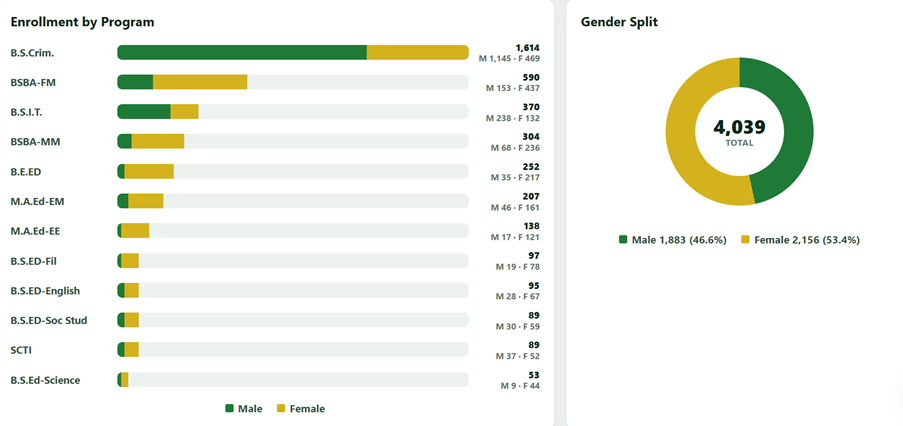
Furthermore, Samar Colleges, Inc. utilizes these longitudinal tracking mechanisms not merely as retrospective reporting tools, but as actionable instruments for inclusive academic planning. Recognizing that sustained female access at the point of entry (57.6% among first-year enrollees) must be matched by equitable persistence and progression through graduation (50.8% among fourth-year students, at 551 of 1,084 enrollees), the institution leverages cohort-level data to inform targeted student retention, mentorship, and scholarship initiatives. Concurrently, by isolating persistent gender disparities in specialized fields such as criminology and information technology, SCI establishes a clear empirical foundation for designing gender-responsive career orientation, bridging programs, and institutional policies that dismantle structural barriers and expand women’s participation across every academic pathway.
Source: SCI Enrollment Dashboard – AY 2026–2027, 1st Semester